
Pillar 06 of 7
Circular Economy
From take-make-dispose to a closed loop: minimizing waste and maximizing every resource.
Overview
The circular economy pillar focuses on minimizing waste and maximizing resource use to build a sustainable and resilient economy, transitioning from a linear take-make-dispose model to a circular one where resources are used efficiently, regenerated, and recycled at the end of their lifecycle.
Key strategies include reducing waste through prevention, recycling, and reuse; mandating recycling and upcycling programs; and improving waste management systems. The approach also aligns with the Government's focus on marine conservation by reducing land-based pollution, and seeks to strengthen the local economy by developing value-added products from waste.
Key Facts
- The Federation generates 32,363 metric tons of waste annually, averaging 1.67 kg per person daily, above the regional average of 0.99 kg.
- St. Kitts and Nevis ranks fourth globally in per capita waste generation.
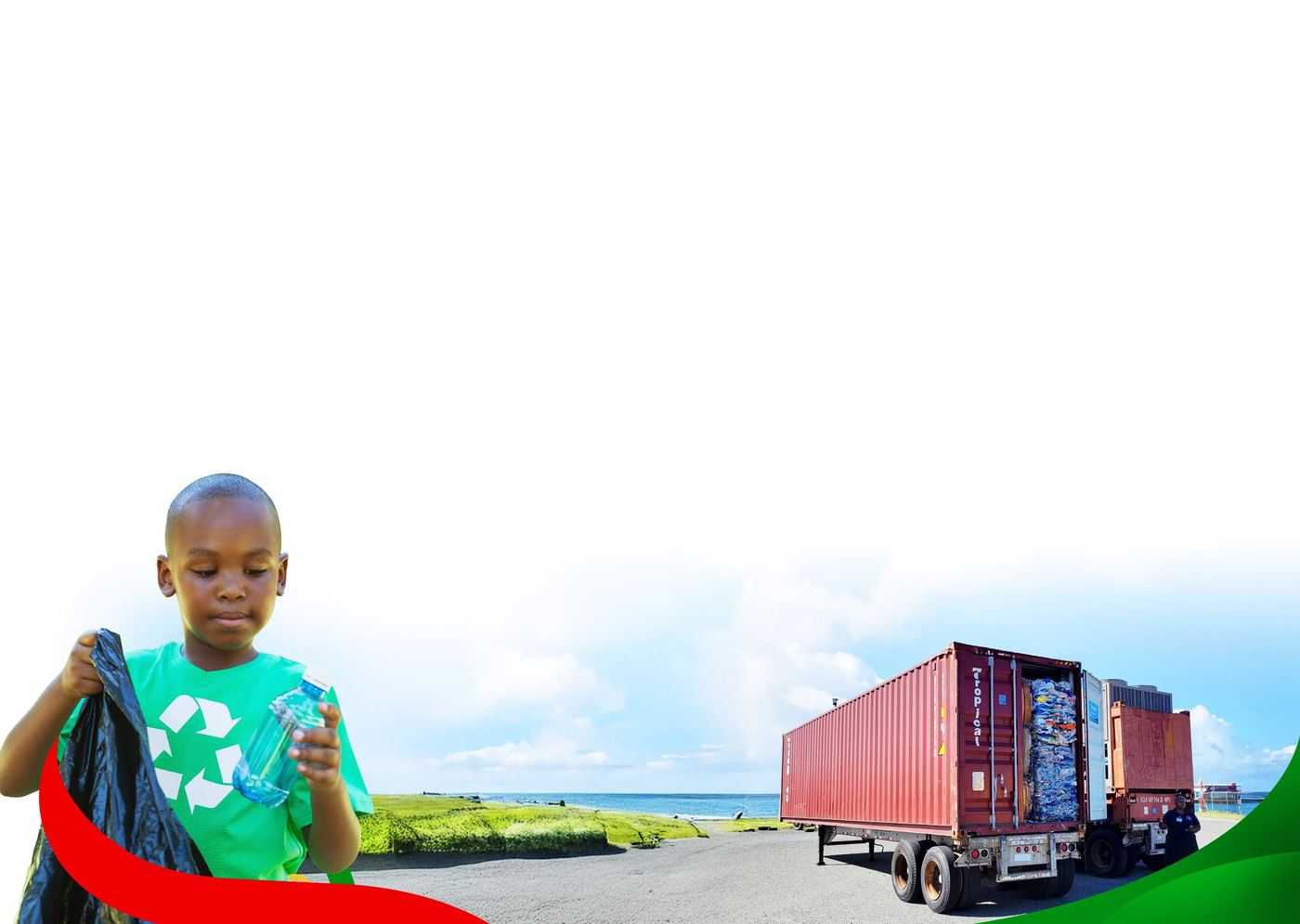
- The St. Kitts Solid Waste Management Recycling Project boosted plastic recycling from 38,749 pounds in 2022 to 73,492 pounds in 2023.
- Importation of single-use plastic shopping bags was banned effective 31 December 2024.
- Public solid waste collection serves 95% of households.
- The island has limited landfill capacity, posing a significant challenge.
Our landfill is bursting at the seams with plastics. What was once thought of as a viable solution to paper based products has now become the gravest problem for our oceans. St Kitts and Nevis must now do its part to protect lives and livelihoods.
Hon. Dr. Joyelle Clarke
Minister of Sustainable Development, Environment and Climate Action and Constituency Empowerment
Goals and Targets
- Reduce waste through prevention, reuse, recycling, and upcycling.
- Implement mandatory recycling programs and transform waste into resources.
- Develop waste infrastructure: sanitary landfills, hazardous waste sites, and waste-to-energy facilities.
- Promote sustainable consumption and efficient resource use.
- Support marine and environmental conservation by reducing land-based pollution.
- Create sector-specific policies with incentives for tourism and manufacturing.
- Launch public awareness campaigns and enhance data systems with baseline studies.
Solid Waste Management and Recycling Project
The US$1 million Solid Waste Management Project, in collaboration with Taiwan, features drop-off stations and bin placement programs, alongside a recycling plant in Nevis and a plastic recycling system at the Lowlands landfill.
Public awareness campaigns like Plastic Free July, regional collaboration in the Circular Economy Coalition, and a pilot grey water treatment system in Basseterre further support the transition, with plastic recycling nearly doubling in a single year.
Key Achievements
- Incorporated circular economy principles into the National Development Planning Framework 2023-2037.
- Established a recycling plant in Nevis and a plastic recycling system at the Lowlands landfill.
- Launched the US$1M Solid Waste Management Project with Taiwan.
- Organized campaigns like Plastic Free July to promote environmental stewardship.
- Joined the Regional Coalition on Circular Economy for Latin America and the Caribbean.
- Implemented a pilot grey water treatment system in Basseterre.
Investment Priorities
- Expand recycling facilities, improve disposal sites, and enhance collection infrastructure.
- Invest in solar, wind, waste-to-energy, and electric vehicle infrastructure.
- Expand grey water systems, improve storage, and explore desalination.
- Promote eco-tourism, local manufacturing, and climate-smart agriculture.
- Digitize systems and support waste management research and development.
- Train workers, raise awareness, and invest in education.
- Develop circular economy policies and simplify investment processes.
How far we have come
St. Kitts and Nevis is advancing its transition through circular economy integration in national planning, new recycling infrastructure, waste collection covering 95% of households, and regional collaboration, reflecting strong progress under the Sustainable Island State Agenda. Progress is determined by NDPF indicators.